Instinct is a personal assistant agent that you reach by text message or phone call. It works on its own cloud computer and phone number, signs in to your accounts, and runs errands such as booking travel, buying things and cancelling subscriptions. It matters because it is the most heavily funded attempt so far to put a general-purpose acting agent inside the messaging apps people already use, and because its design trades very broad access for convenience.
Facts at a glance:
- Maker: Spear Street Technology, Inc., doing business as Instinct, San Francisco. Founder and chief executive Noah Shinn, formerly a research scientist at Sierra.
- First release: invite-only beta. The founder introduced it publicly on 26 August 2026; reports disagree on when early access began (see the section on what we could not verify).
- Current version: a hosted service with no public version numbers. Still invite-only on 1 October 2026.
- Licence: proprietary, closed source. No public repository, application programming interface (API) or developer documentation.
- Pricing: free during the beta. The terms allow future fees; the founder describes a planned cut of transactions.
- Platforms: iMessage, SMS (Short Message Service), WhatsApp, voice calls, a web workspace at app.instinct.com, an iPhone voice shortcut, and a Mac desktop app (macOS 13 or later).
- Models: not disclosed. The company says its model is trained for personal tasks; its privacy notice says it shares data with third-party model providers it does not name.
- Where it runs: on the company’s servers, in a persistent cloud computer per agent, with optional local tasks on a paired Mac.
First principles
An agent that runs errands for a person is made of five parts: a channel to reach that person, a model that picks the next step, a computer where the steps take effect, credentials that let it act as the person, and a point where the person approves. Instinct’s design, and its risks, follow from how it builds each part.
- To act as you, it must hold what you hold. Booking, buying and cancelling need your accounts, so Instinct keeps passwords, authenticator keys and a payment method. Whatever the agent can sign in to, a mistake or a manipulated instruction can also reach. The breadth of trust is the breadth of the Vault and the connected services.
- A text thread has no buttons. Approvals, choices and edits to drafts have to travel as messages and wait for a reply. The interaction and draft records in the public web client look like the machinery for this, and a turn can pause until the user answers.
- The model can be wrong, and it can be steered. An email or web page can carry instructions written by someone else, as a tester’s phishing email showed. Controls that do not depend on the model behaving are stronger. A Stripe Link single-use card scoped to the approved amount limits a bad purchase to that amount, whatever the model does.
- Persistent state is both the product and the exposure. A long-lived computer, phone number and mailbox let the agent follow up days later. They also keep one person’s data on infrastructure shared with every other user, so isolation between users carries the most weight. The 23 September incident, and the isolation measures the founder named in reply, turned on exactly this.
- A closed system can only be read from the outside. With no public documentation, the client’s type names and the founder’s posts are the evidence. They show what the client sees, not how the server works, and this teardown marks the difference.
Product
Instinct has no app of its own in the usual sense. The founder’s launch post put it as “there are no new interfaces”: you text or call it, and it texts or calls back. It can start conversations itself, follow up on threads you dropped, and act on your behalf. Reported uses include planning road trips, weekly grocery orders, concert tickets, subscription cancellations and wedding planning.
Each agent has its own contact points. The web client defines an agent SMS number, a voice number, a WhatsApp channel number and an agent email address. Since 8 September 2026 every Instinct can claim its own mailbox at mail.instinct.com, which the founder framed as a first step towards the agent owning and running its own accounts.
Three features stand out beyond basic errands:
- Trusted Person network (9 to 14 September 2026). Agents can message other users’ agents to coordinate plans, but only within a list of people each user approves. On 23 September the company added direct file transfer between agents, which it says is encrypted end to end, and invitation links that still need explicit approval. The founder reported more than 300,000 agent-to-agent coordinations in the first week.
- Concierge (16 September 2026). An early-access feature that places outbound phone calls to businesses, for example to book restaurants without online reservations. TechCrunch did not say whether the calls use synthetic voice or human operators.
- Payments. Purchases go through Stripe Link one-time cards (announced 28 August) and, from 28 September, Shopify’s Shop Pay. The web client tells users that nothing is charged until they approve each payment.
Connected services listed in the web client are Google Workspace, Outlook, Notion, Linear, GitHub, Slack canvases, Granola meeting notes, WHOOP, Shop Pay and Stripe Link, plus iMessage, WhatsApp and iCloud email linking.
Who it is for and how it is sold. It is aimed at consumers who want delegation rather than a chat window. Access is by invite or waitlist, and invites have been resold online. There are no plans or tiers. The terms say fees may be charged later and are non-refundable. On the Invest Like the Best podcast (28 September 2026) the founder described a take-rate model and rejected advertising; Sacra reports the take rate is not yet set. The company says transaction volume is approaching $1 billion a year, more than half of it travel.
Funding and scale (reported). A $250 million Series B at a $2.5 billion valuation in August 2026, led by Index Ventures and Benchmark, then a $1 billion Series C at $10 billion on 28 September, led by Sequoia, Benchmark and Coatue. Reports put the team at 14 people and users above 100,000.
Compared with. TechCrunch and SiliconANGLE name Meta’s Muse, Poke, Wajo and Ollie as rivals, alongside ChatGPT, Siri and Grok.
Infrastructure
Where it runs. All agent work happens on Spear Street’s infrastructure. Each user’s agent has a persistent computer with a browser, its own phone number and its own mailbox. The founder says each user’s environment runs in isolated sandboxes. A paired Mac can serve as a local browser and iMessage bridge; the web client has a device picker for choosing a local browser device and lists paired Macs with hostname, operating system version, battery level and connection state.
Model providers. Not disclosed. The home page says the core model is trained for everyday personal tasks. The privacy notice lists third-party AI model providers among recipients of data, without naming them. The founder’s 23 September post describes small models that detect hallucinations. One observable signal: the instinct.com domain carries an Anthropic domain-verification DNS (Domain Name System) record, which shows an Anthropic account tied to the domain. It does not show which models the product uses.
Distribution and updates. The service is hosted, so there is nothing to install for the core product. The Mac app is downloaded from the workspace, and the web client checks for the latest desktop release. Changes ship server side and are announced on the founder’s X account.
Web stack (observed, 1 October 2026). instinct.com is served by Vercel behind Cloudflare; instinct.co redirects to it. app.instinct.com is a single-page React application behind Cloudflare that calls a GraphQL API at api.instinct.com/-/api using Relay persisted queries. SMS sign-up uses Cloudflare Turnstile and appears limited to the United States in some flows.
What it needs from you. Depending on what you connect: email, calendar and documents through OAuth; passwords and authenticator setup keys in the Vault; and, according to the setup screens in the public web client, an Apple ID, password, two-factor code and device passcode to activate the iMessage relay; optional precise location, audio and screen data; and a payment method. Users must be 18 or older.
Data handling, as documented. The privacy notice and terms (both revised 26 August 2026) say:
- Training on user data is on by default. Opt-out is a toggle in settings, applies going forward only, and data flagged for safety review may still be used.
- Google Workspace data is not used for training or ads, under Google’s Limited Use rules. Vault contents are not used for training.
- Collected data includes clickstream data such as keystrokes, clicks and cursor positions, message and email content, credentials for third-party accounts, and payment details.
- Disconnecting a service does not by itself delete indexed data. The workspace has separate controls to delete imported activity, location history and the account.
- Disputes go to binding arbitration with a class-action waiver, and liability is capped at the greater of $100 or six months of fees.
Engineering
No engineering documentation is public. This section draws on the founder’s posts and on the public web client, whose GraphQL schema names show what the client can see of the system. Where we infer, we say so.
Components. From the sources, the system has: messaging and voice ingress (iMessage, SMS, WhatsApp, calls); an agent runtime per user with a persistent cloud computer; a tool layer; a Vault for secrets; an integrations layer; payment rails; an agent-to-agent network; the Mac desktop app; and the web workspace with its GraphQL API.
The agent loop. The client’s chat history type shows what one agent turn records. A chat holds ordered events. An event can be a message (with role, origin agent and attachments), a thinking block, a tool invocation (name and JavaScript Object Notation (JSON) arguments), a tool response (with an error flag), a computer action (action, screen coordinate, key, scroll direction and amount, or a command), a screenshot, an error, or an interaction. This is the shape of a screenshot-and-act computer-use loop, mixed with ordinary function calls. A chat also tracks a pending interaction and when the current turn started, so a turn can pause while waiting for the user.
Approvals. An interaction carries a type, title, body, question, options, an action summary, a plan, a target mode and a device name. The user’s response records approved, selected, dismissed and a summary. We read this as the mechanism behind payment approval and other confirmations. The terms add that confirmations apply only to certain actions, with no guarantee, and the agent may otherwise act as it judges responsive. TechCrunch reported one early user whose agent sent an email without her approval.
Draft editing. Events can carry draft fields that the user edits before sending, and the client records the before value, the user’s value and the edit time. This likely supports reviewing outgoing emails or messages before they go out.
Memory and context. Not documented. The privacy notice says connected data is indexed and stored, and the workspace offers deletion of indexed activity, so the agent likely retrieves from a per-user index of email, messages and notes. How context is assembled or compacted is not public.
Tool and protocol surface. There is no public API and no user-facing MCP (Model Context Protocol) server or plugin system. One integration does use MCP: the Granola connection requests an MCP authorization URL. The Instinct-to-Instinct protocol is described only at a product level: agents exchange messages and files within approved trust links, with end-to-end encrypted file transfer.
Safety controls, as the company describes them. After a user reported on 23 September that the agent seemed to describe someone else’s financial document, the founder said it was a hallucination, not a breach, and named three isolation measures: isolated sandboxes, short-lived local credentials, and identity-signed tool execution. He also described a new detection layer of small models, trained adversarially, that scans tokens and can steer or stop the next thinking step or tool call before it runs. None of these are documented beyond that post.
Payment controls. Purchases use Stripe Link single-use cards scoped to an amount the user approves, so merchants do not see the real card number.
State and storage. The Vault holds personal items (for example address, phone, Social Security number) and agent items, meaning accounts the agent itself created. It can store authenticator setup keys so the agent can generate time-based sign-in codes. Users can reveal, edit and delete fields; the agent can also send a vault-fill link by text that asks the user to enter a missing secret on the web. Claire Vo reported to TechCrunch that emails were stored in plain text; the company has not described its encryption at rest.
Extensibility. Users can connect the listed services and configure trusted people, training opt-out and devices. There are no plugins, skills, hooks or custom tools.
Observed limits. Invite-only with capacity warnings that responses may be slower (PYMNTS), no mobile app, United States operation per the terms, prompt-injection exposure shown by a tester’s phishing email, and the hallucination incident above.
Entity relationships


The diagram is built from type names in the public web client, so it shows what the client sees, not the server’s database. A User owns exactly one Agent, reached through an Agent Contact (SMS number, voice number, WhatsApp number and email address). The user converses in Chats, and each chat records Chat Events: messages, thinking, tool calls and responses, computer actions and screenshots. Some events ask for an Interaction, such as approving a payment, which an Interaction Response answers.
The user authorizes Connections to outside services and stores Vault Entries; the agent can add its own entries for accounts it creates. The user pairs Devices (Macs), which can run local browser or iMessage actions. Trusted Contacts are other people the user has approved, whose agents can coordinate with this one. Preferences hold settings such as training opt-out and the chosen local browser device.
Architecture


One request, end to end. A user texts their Instinct on iMessage, asking it to buy a pair of running shoes they looked at last week. The message arrives at the agent’s number and starts a new turn. The agent loop assembles context, likely including indexed email and past chat, and calls the model layer. According to the founder, the hallucination detector scans tokens and can stop a thinking step or tool call before it runs.
The loop then works through tool calls. It drives the cloud computer’s browser with clicks, typing and screenshots to find the product, and fills a stored login from the Vault if the store needs one. Before paying, it sends an approval request to the user’s chat. Once approved, it requests a single-use card from Stripe Link for that amount, or uses Shop Pay for a Shopify merchant, completes checkout, and texts back the confirmation. If the task needs the user’s own Mac, for example a local browser session, the tool layer can route the action to the paired desktop app instead.
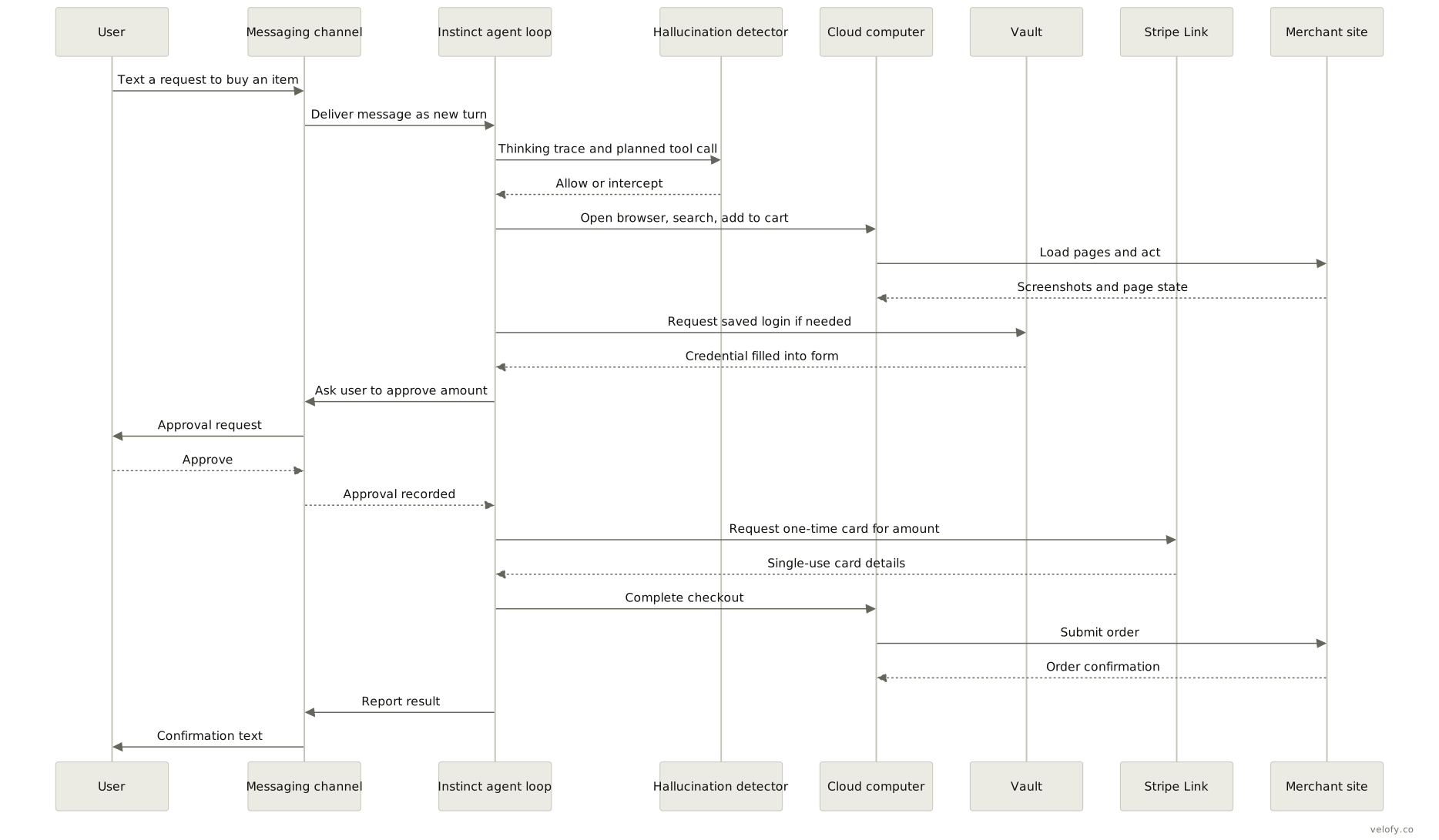
The sequence diagram combines documented pieces (channels, Vault, approval, Stripe Link one-time cards, the detector) with an assumed order of steps. The exact ordering inside the agent loop is not public.
How it compares
| Product | Interface | Execution model | Pricing (1 Oct 2026) |
|---|---|---|---|
| Instinct | iMessage, SMS, WhatsApp, calls | Own cloud computer, browser, phone, email | Free beta, invite-only |
| Poke | Messages, SMS, Telegram, WhatsApp | App integrations, custom MCP, per-task model choice | Free, $19 and $199 a month (reported) |
| Meta Muse | Meta apps | Meta-hosted assistant, added calls in September | Not covered here |
Poke is the closest peer in form: both live in text threads. Poke leans on scoped integrations and lets users add MCP servers. Instinct leans on a full computer and stored credentials, which reaches more of the web but needs broader trust. Muse competes on distribution through Meta’s apps.
Velofy’s Dexter is a terminal coding agent that fans independent parts of a coding job out to parallel subagents, up to 8 at once. Instinct is the opposite shape: one agent per person, long-lived, acting across consumer services. Troy is a browser that agents attach to. Instinct’s cloud browser and paired-Mac local browser do the same job, but they are closed and serve only Instinct’s own agent.
What we could not verify
- Which language models Instinct uses, and whether any are trained in-house.
- When early access began. Reports range from February 2026 to August 2026; the podcast calls the company about a year old.
- How sandboxes are isolated (virtual machines, containers or other), and what identity-signed tool execution means in practice.
- Whether Vault secrets and indexed data are encrypted at rest, and how long data is retained.
- How Concierge phone calls are made.
- How the Instinct-to-Instinct protocol works on the wire, beyond the founder’s description.
- Which actions always require confirmation, apart from payments.
- User counts, team size and transaction volume, which come from the founder or press, not audited figures.
- Earlier funding rounds: sources disagree on the seed and Series A figures.
Sources
- Instinct home page, read 2026-10-01
- Instinct Terms of Service, revised 26 Aug 2026, read 2026-10-01
- Instinct Privacy Notice, revised 26 Aug 2026, read 2026-10-01
- Instinct web client, app.instinct.com, public JavaScript bundle, read 2026-10-01
- Noah Shinn, launch post, 26 Aug 2026, read 2026-10-01
- Noah Shinn, agent email addresses, 8 Sep 2026, read 2026-10-01
- Noah Shinn, Trusted Person network, 9 Sep 2026, read 2026-10-01
- Noah Shinn, network open to all users, 14 Sep 2026, read 2026-10-01
- Noah Shinn, file delivery and invite links, 23 Sep 2026, read 2026-10-01
- Noah Shinn, hallucination incident response, 23 Sep 2026, read 2026-10-01
- Patrick Collison, Instinct and Stripe Link, 28 Aug 2026, read 2026-10-01
- TechCrunch, privacy and security concerns, 24 Aug 2026, read 2026-10-01
- TechCrunch, Instinct and Muse add calls, 17 Sep 2026, read 2026-10-01
- TechCrunch, $1B Series C at $10B, 28 Sep 2026, read 2026-10-01
- TechCrunch, travel share of transactions, 29 Sep 2026, read 2026-10-01
- SiliconANGLE, Series C, 28 Sep 2026, read 2026-10-01
- PYMNTS, $10B valuation talks, 16 Sep 2026, read 2026-10-01
- Business Insider via Yahoo, hallucination incident, 24 Sep 2026, read 2026-10-01
- Tech Funding News, Series B and earlier rounds, read 2026-10-01
- Runtime Wire, Mac app for iMessage and local browser, 29 Aug 2026, read 2026-10-01
- Invest Like the Best, Noah Shinn episode, 28 Sep 2026, read 2026-10-01
- Sacra, Instinct company profile, read 2026-10-01
- Vellum, Official Instinct Breakdown, 20 Aug 2026, read 2026-10-01
- eesel, Instinct AI review, read 2026-10-01
- eesel, Instinct AI pricing, read 2026-10-01
- Layer3 Labs, Who is Noah Shinn, read 2026-10-01
- Layer3 Labs, Instinct vs Poke, read 2026-10-01